
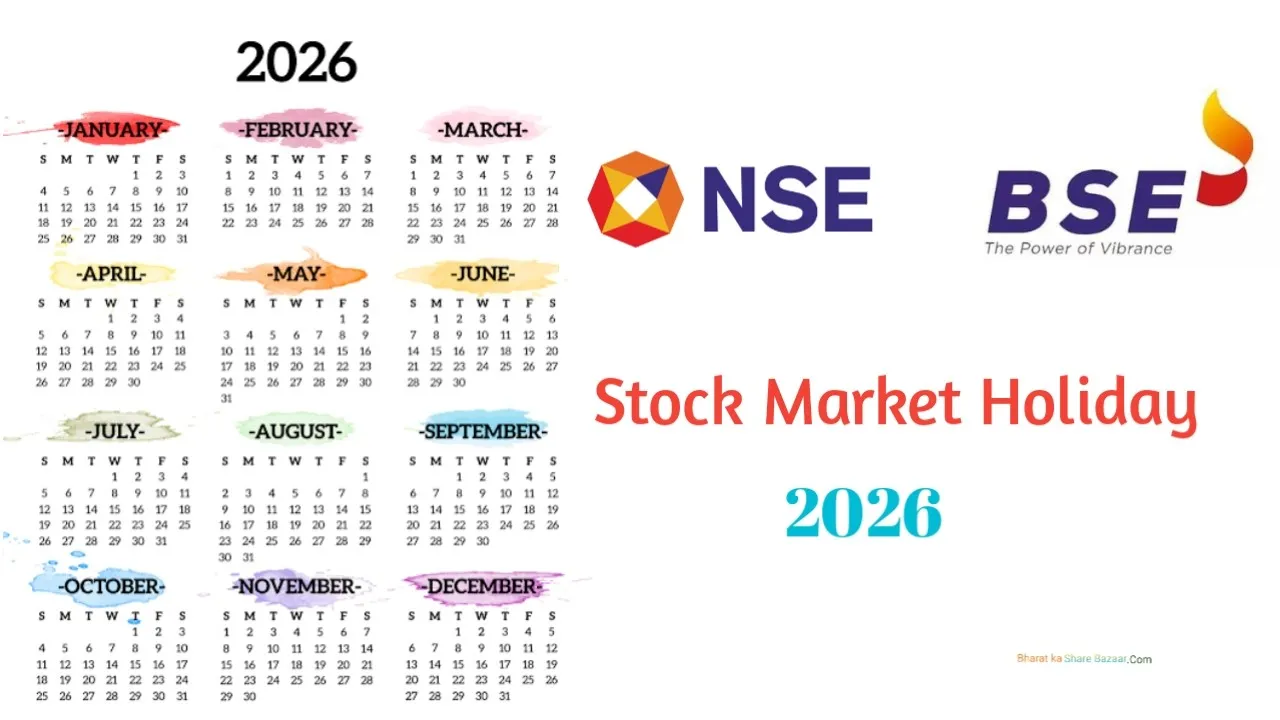
Stock/Share Market Holidays in 2026
The 2026 stock market holiday calendar is now officially out for major exchanges such as the National Stock Exchange (NSE) and Bombay Stock Exchange (BSE) in India. For investors, traders, and financial professionals, knowing when the markets are closed is vital for planning trading strategies, settlement actions, and portfolio adjustments.
Indian Stock Market Holiday Calendar (2026)
In 2026, the Indian stock markets — NSE, BSE, and related segments like equity and derivatives — will remain closed for trading on 15 official holidays. These include national events, religious festivals, and statutory observances.
List of Official NSE & BSE Trading Holidays (2026)
| Date | Day | Holiday Name |
| Jan 26, 2026 | Monday | Republic Day |
| Mar 03, 2026 | Tuesday | Holi |
| Mar 26, 2026 | Thursday | Shri Ram Navami |
| Mar 31, 2026 | Tuesday | Shri Mahavir Jayanti |
| Apr 03, 2026 | Friday | Good Friday |
| Apr 14, 2026 | Tuesday | Dr. Baba Saheb Ambedkar Jayanti |
| May 01, 2026 | Friday | Maharashtra Day |
| May 28, 2026 | Thursday | Bakri Id |
| Jun 26, 2026 | Friday | Muharram |
| Sep 14, 2026 | Monday | Ganesh Chaturthi |
| Oct 02, 2026 | Friday | Mahatma Gandhi Jayanti |
| Oct 20, 2026 | Tuesday | Dussehra |
| Nov 10, 2026 | Tuesday | Diwali – Balipratipada |
| Nov 24, 2026 | Tuesday | Prakash Gurpurb (Guru Nanak Dev) |
| Dec 25, 2026 | Friday | Christmas |
These dates represent full-day market closures. On these days, equity, derivatives, and related segments won’t have regular trading sessions.
Notes on Specific Holidays
Diwali and Muhurat Trading
- Although Diwali Laxmi Pujan (Nov 08, 2026) falls on a Sunday and doesn’t lead to a market holiday, exchanges traditionally conduct a special Muhurat Trading session. The timing will be announced closer to the date.
Weekends & Festivals
- Several important festivals such as Mahashivratri (Feb 15), Eid-ul-Fitr (Mar 21), and Independence Day (Aug 15) fall on weekends in 2026, so they do not cause additional closures.
Significance of Knowing Market Holidays
Understanding the holiday calendar is essential for:
- Strategizing Trades: Avoid placing orders on market closure days.
- Settlement Planning: Prevent delays in clearing and settlement operations.
- Portfolio Rebalancing: Align decision-making around market liquidity windows.
- Risk Management: Anticipate potential gaps in pricing when markets reopen.
Advance notice of holidays also helps investors plan around long weekends, potentially using the non-trading days to refine strategies or execute research.
Global Stock Market Holidays
While this article primarily focuses on Indian exchanges, major global markets also observe holidays:
U.S. Markets (NYSE & NASDAQ)
- New Year’s Day (Jan 1, 2026) – Closed
- Martin Luther King Jr. Day (Jan 19)
- Presidents’ Day, Memorial Day, Juneteenth, Labor Day
- Thanksgiving and Christmas Day are among other closures.
Other World Markets
- Exchanges in Japan, South Korea, Hong Kong, Europe, and Australia have varying holiday schedules — often observing New Year’s, national days, and local festivals.
These global closures can impact international trading strategies, cross-border arbitrage opportunities, and liquidity cycles.
Tips for Investors & Traders in 2026
- Mark all full-day market holidays in your trading calendar.
- Plan trading activities around long weekends to manage risk and capital deployment.
- Monitor notifications from exchanges for any updates or special sessions (e.g., Muhurat trading).
- Remember that settlement and currency derivatives segments may have additional or different holidays.
Summary
The NSE and BSE officially scheduled 15 trading holidays for 2026, reflecting a blend of national, cultural, and religious observances. Early awareness of these non-trading days supports better planning for everyday investors and professional traders alike.

Mera naam Gopal Pramanik hai aur main ek Stock Market Enthusiast, Blogger aur Financial Content Creator hoon. Main Bharat Ka Share Bazaar.Com ka founder hoon, jahan par main logon ko Share Market, Investing aur Financial Awareness ke baare me simple aur practical knowledge provide karta hoon.