
Union Budget 2026–27: Major Tax Announcements
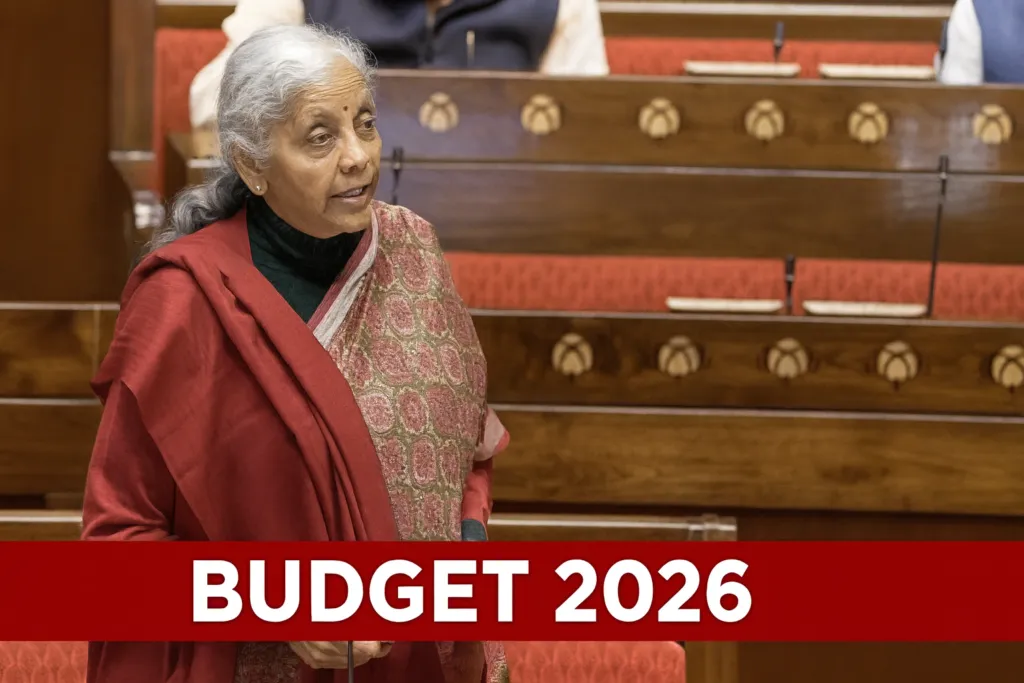
New Delhi, 1 February 2026 — Finance Minister Nirmala Sitharaman presented the Union Budget 2026–27 in the Lok Sabha today, marking her ninth consecutive Budget presentation. The Budget speech focused on economic growth, fiscal stability, infrastructure spending, and a series of tax reforms aimed at simplifying compliance and boosting investment — though it avoided changes to standard individual income tax slabs.
1. New Income Tax Law to Replace 1961 Act
One of the most significant tax announcements was the rollout of the Income Tax Act, 2025 — a completely new direct tax law that will come into effect from 1 April 2026. This new Act replaces the six-decade-old Income Tax Act of 1961 and is aimed at simplifying tax laws, reducing litigation, and making compliance easier for individuals and businesses.
Although tax rates and slabs remain largely unchanged, the move to a new unified tax code represents a major structural overhaul of the Indian tax system. Under the new framework, complex provisions have been significantly reduced, and several procedural burdens have been eased.
2. Individual Income Tax: No Changes in Slabs
Contrary to expectations from some quarters, there has been no revision of the existing income tax slabs for individual taxpayers. The current structure in the new tax regime remains intact, with zero tax up to ₹4 lakh and progressive rates up to 30% for income above ₹24 lakh. The standard deduction for salaried employees at ₹75,000 has also been retained.
This decision has drawn mixed reactions from taxpayers and analysts, with some expressing disappointment for the absence of relief for middle-class households.
3. Exemptions and Targeted Tax Reliefs
Despite no slab changes, the government announced a series of targeted tax breaks and exemptions to benefit specific groups:
- Interest from Motor Accident Claims Tribunal (MACT) awards will be fully exempt from income tax, and no Tax Deducted at Source (TDS) will be levied on such amounts. This move aims to ensure that victims receive full compensation.
- Lower TCS on overseas education and medical remittances — The Tax Collected at Source (TCS) rate on remittances under the Liberalised Remittance Scheme (LRS) for education and medical purposes has been reduced from 5% to 2%, providing relief to families funding education abroad.
- Exemption from Minimum Alternate Tax (MAT) for certain non-resident taxpayers paying tax under the presumptive basis — this simplifies taxation and encourages NRI investment participation.
- Doubling investment limits for NRIs — The individual investment cap for Non-Residents has been raised to 10%, aimed at facilitating enhanced participation in Indian markets.
4. Corporate Tax Measures and Market-Related Levies
The Budget also introduced a number of corporate tax reforms and market-related tax changes:
- MAT has been restructured, with the government proposing to treat it as a final tax, and reducing the MAT rate from 15% to 14% for certain eligible companies, while facilitating MAT credit set-offs only for companies opting into the new tax regime.
- Securities Transaction Tax (STT) on futures has been increased, which triggered significant volatility in brokerage stocks on the markets.
- Buybacks of shares will now be taxed uniformly as capital gains, reducing arbitrage opportunities and aligning promoters with non-promoter investors.
- TCS and TDS rationalisations: Some goods and services — including scrap and alcoholic liquor — will see TCS at 2%, and simplified TDS regimes were announced for manpower supply and other specific categories.
5. Policy and Macro Tax Reforms
Beyond direct tax provisions, the Budget indicated broader structural tax policy direction:
- Tax holiday extensions — The tax holiday for businesses in GIFT City has been extended to 20 years, strengthening the attractiveness of this financial hub for global capital.
- Rationalizing customs exemptions on certain capital goods and inputs to promote domestic manufacturing.
6. Market and Public Reaction
Reactions to the Budget have been mixed: while industry leaders highlighted the positive implications for ease of doing business and regulatory simplification, opposition figures criticized the lack of direct relief for the common taxpayer. Markets reacted negatively on some fronts, especially in equities sensitive to tax changes.
Conclusion: A Budget for Stability and Structural Reform
Union Budget 2026–27 emphasizes structural tax reform, compliance simplification, and investment incentives, while maintaining fiscal prudence. The new Income Tax Act, 2025, represents a cornerstone of this strategy, signaling a major shift in India’s tax architecture — even though immediate tax rate relief for individuals is limited. With targeted reliefs and specific exemptions, the government seeks to balance ease of compliance and economic growth objectives in a complex global environment.